
FDA internships: A place to pursue a career
For the past five years, the FDA has run an annual paid summer internship for students or recent graduates looking for a career in an environment like our union. Katherine Hutchinson spoke to some of our past interns to find out what they gained from the experience and where they are now.
Aoife Donaghy

Aoife Donaghy undertook the FDA’s internship project earlier this year, looking at the role of automation in the civil service, with a particular focus on artificial intelligence. Donaghy became interested in applying through her experience on the civil service’s summer internship, and says it felt like “a natural progression opportunity. I’d had some research experience and I’d spent time with civil servants, and so it felt like I could bring something to the table in terms of having a basis of understanding of what the role entailed.”
Donaghy admits that the trade union aspect of the role also appealed: “I feel like the world of trade unions can be a bit of black box when you’re coming from the outside and you have no actual idea of how the day-to-day functioning happens, so that really intrigued me, and I jumped at the opportunity the minute it came up.”
Discussing the purpose of the project and her role within it, Donaghy says: “It was inspired by the fact that the government had made all these commitments to the introduction of digital technology across public services, but especially within the civil service, and had made big promises around things like the time saving that the introduction of digital technology would provide.”
Donaghy outlines that “in collaboration with the Fabian Society think tank, the project looked at, if those promises were going to come to fruition, how best the government could bring civil servants along with them so that they weren’t just mandating massive work and life changes, and could instead enlist them as key partners to deliver the smarter state. We also wanted to look at how feasible a lot of the cost savings and technology implementation would be.
“A lot of my role included looking at how civil servants were thinking and feeling about the implementation of AI and new technologies, how it was currently going, and how they thought it was going to go in the future.”
Discussing the highlights of her experience at the FDA, Donaghy says: “Everyone at the FDA was so willing to speak to me about what their day-to-day job was. I also got involved with some work outside of the project, including things like editing and drafting correspondence. That was really helpful, as I gained more transferable skills than I thought I would, including some insight into what working for the FDA and for trade unions in general is like.”
Donaghy adds that she also appreciated the opportunity to take the initiative in designing the project and undertaking the research, including through conducting focus groups and surveys, which she says “boosted her confidence” and gave her a “really strong baseline of non-academic experience to take into future research focused roles.”
The project and its findings are still ongoing, with conclusions due to be published in early 2026.
Sufyan Ahmed

Sufyan Ahmed undertook the FDA’s summer internship last year, working on a research project which looked at the state of hybrid working in the civil service and how policy surrounding it has continued to evolve in the years since the FDA last examined the issue following the pandemic.
Ahmed became aware of the FDA’s internship programme through his time on the civil service summer internship, which, combined with his interest and involvement with politics and the labour movement, encouraged him to apply. He now works as a senior parliamentary researcher and says the skillsets he gained through the FDA internship have been beneficial in his current role.
Reflecting on the highlights of his experience on the internship, Ahmed says: “I really enjoyed conducting the interviews because I was speaking to very senior people, such as the CEO of a local government. I also had the opportunity to speak with Mark Drakeford, the former First Minister of Wales, to look at the different approach towards hybrid working that the Welsh government had taken. Also, because the response to the survey was so phenomenal with thousands of responses from across the civil service, it was very interesting to see the breadth of opinion on the issue.
Ahmed feels the “big skill” he gained “was in research, including doing a literature review looking at how different countries were approaching hybrid working, and then finding the right people to interview. Designing a whole survey, distributing it, analysing the responses, and then bringing those findings together through writing the report was a really interesting process, as well as then getting that edited and presenting its finding at the report launch on a formal panel.
“I also appreciated the opportunity to work independently. People were really supportive, but ultimately it was my own project and the experience that gave me has been extremely valuable.”
Ahmed used this experience to help move forward in his career: “When I was applying for parliamentary jobs, being able to demonstrate in interviews that I had that experience of working independently, as well as the research skills, was really helpful, I felt that people were very impressed by it.
“Also, in my current role, I have been able to do some work looking at the Employment Rights Bill, and within that there’s some focus on flexible working. So having that experience on the internship has meant that I continue to be really interested in trade unions and employment rights.”
Dev Bahra

Dev Bahra joined the FDA’s internship scheme in 2021, taking part in a research project looking at the future of international development. This followed the 2020 merger of the Foreign and Commonwealth Office with the Department for International Development to form the current Foreign, Commonwealth and Development Office.
Discussing his decision to apply for the FDA’s internship, Bahra says: “Coming out of my degree, I was interested in a role in politics or policy, and I was particularly interested in research and analysis, but also thinking about how you influence change. When I came across the FDA internship, it felt like it was at the intersection of helping to support civil servants, but also influencing wider change and getting the chance to actually develop my skills and look at how research and analysis works in practice, and how you can communicate effectively.”
Discussing the project and the skills he gained through undertaking it, Bahra explained that “a crucial point was that the government had reduced the international aid and development budget from 0.5% to 0.3%, so the project was designed to examine the impact of that. That involved researching and interviewing MPs from across the different political parties to get their perspective and insights about what this could mean, including whether it was a good change in policy or not.
The report also touched on the merger itself and the impact it could have, not only on aid and development, but also on the wider civil service.
Bahra dedicated his time to “researching which MPs could offer the most valuable insights based on their own expertise, for example if they were ministers in the past, if they had particular areas of interest or were on different select committee groups, and then had the opportunity to interview them, asking all sorts of questions about their perspective on the impact the budget cut would have on the wider government and international aid policies”.
“Once we’d completed the research and analysis phase, I worked with a couple of people within the FDA to write the report, and then we looked at actually getting it out there. That meant thinking about which publications it would be useful to reach out to, and also organising a webinar where I was able to speak about my work and its impact.”
The final report, Agenda for International Development, provided conclusions and recommendations for the civil service, future models for delivering the aid agenda and insight into the impact of cuts. It helped inform the creation of the FDA Association for Development and Diplomacy, the union’s section for the then newly-formed FCDO.
Utilising the experiences gained within the project, shortly afterwards Bahra was successful in getting a graduate analyst role in a policy and communications firm. He felt “this touched on the skills that I developed at the FDA, and I was able to use those experiences throughout the application process”.
Bahra has since secured a role within the civil service, where he now works in the UK Health and Security Agency, having successfully completed the data science graduate programme. Reflecting on how the internship supported his entry into the civil service, he says: “It was really useful to get the chance during the internship to have guidance from civil servants on approaches to applying for civil service roles, and to hear how they grow and develop in their career… Something that has really stuck with me from doing the internship is that it gave me that initial interest in both research and analysis, and also in the civil service as a place to pursue a career.”
Euan Stock

Euan Stock was the FDA’s intern in 2022, working on a project which looked at the state of hybrid working in the civil service, then a growing issue following the COVID-19 pandemic.
Stock says he found the issue of hybrid working particularly interesting due to the scrutiny the civil service was under from politicians and the media at the time, and he was keen to contribute to a project which researched the realities of hybrid working, including both the opportunities and challenges it presented for civil servants’ real life working experiences.
One of the highlights of Stock’s experience on the FDA internship was having the opportunity to take the lead on designing the research strategy for the report, which included running focus groups and conducting surveys: “The process of writing the questions for the focus groups, which I started from near scratch, was really interesting. Then having them workshopped and adjusting the questions based on feedback, and actually running the focus groups, asking the questions and follow-ups, and guiding that conversation as I saw fit, was great experience. It could have been quite daunting, but everyone was really supportive, and although I did feel quite stretched by it, I found it really interesting hearing the range of opinions the participants shared.”
Stock helped ensure that the research he conducted came from a diverse range of areas: “We looked at the impact of hybrid working on local high streets, and also included examples from other countries, specifically looking at the hybrid working practices of a company based in Poland. I also held a number of meetings with different stakeholders, including companies, charities, and advocacy groups. There was a lot of faith put in me to have those conversations, to ask the questions that I thought were worthwhile.
“When the overall report was completed and published, we were able to make an objective argument about how effective hybrid working policy was at the time, and dispel some of the more careless things that some politicians were saying, because the feeling was that members were coming under a pretty concerted attack and it wasn’t very fair.”
Stock is now in his final year of a local government graduate scheme, where he says he has found his placements in policy and strategy particularly interesting. He feels that his experiences undertaking the FDA’s research project gave him “a strong foundational skillset for his current role”, and that his “confidence to work independently was boosted through the process”.
What is the FDA intern programme and how did it begin?
In 2021, the FDA Executive Committee agreed to a suggestion from General Secretary Dave Penman to run a six-week summer internship, to help share “our unique mix of trade union/politics/government” with “a graduate or those who are thinking of this type of world of work”. Importantly, it was agreed that the internship should “of course” be paid.
In the years that have passed, the number of applications have grown into the multiple hundreds. We have used the opportunity to focus campaigns on our members’ views and concerns about the issues of the day, as well as enabling us to engage with other organisations, culminating in this year’s joint project with the Fabian Society. In return, we have shared the union’s experience – and access to a number of roles and levels across the civil service and government – with talented individuals on the first rung of their career ladder.
Information on the 2026 internship will be available from Spring next year.
Latest news
-
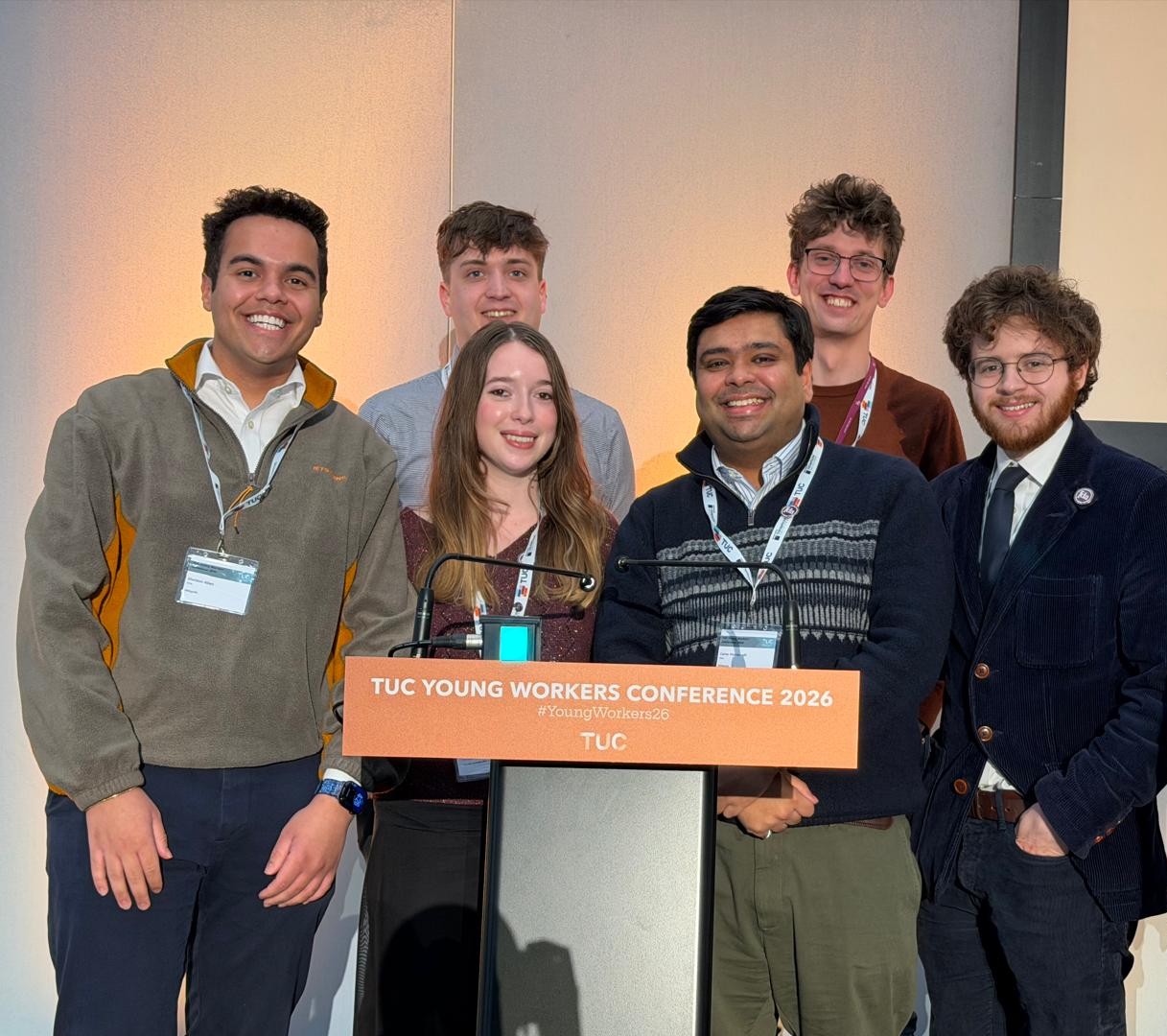
FDA delegation attends TUC Young Workers’ Conference 2026
An FDA delegation attended this year’s TUC Young Workers’ Conference in Brighton.
-
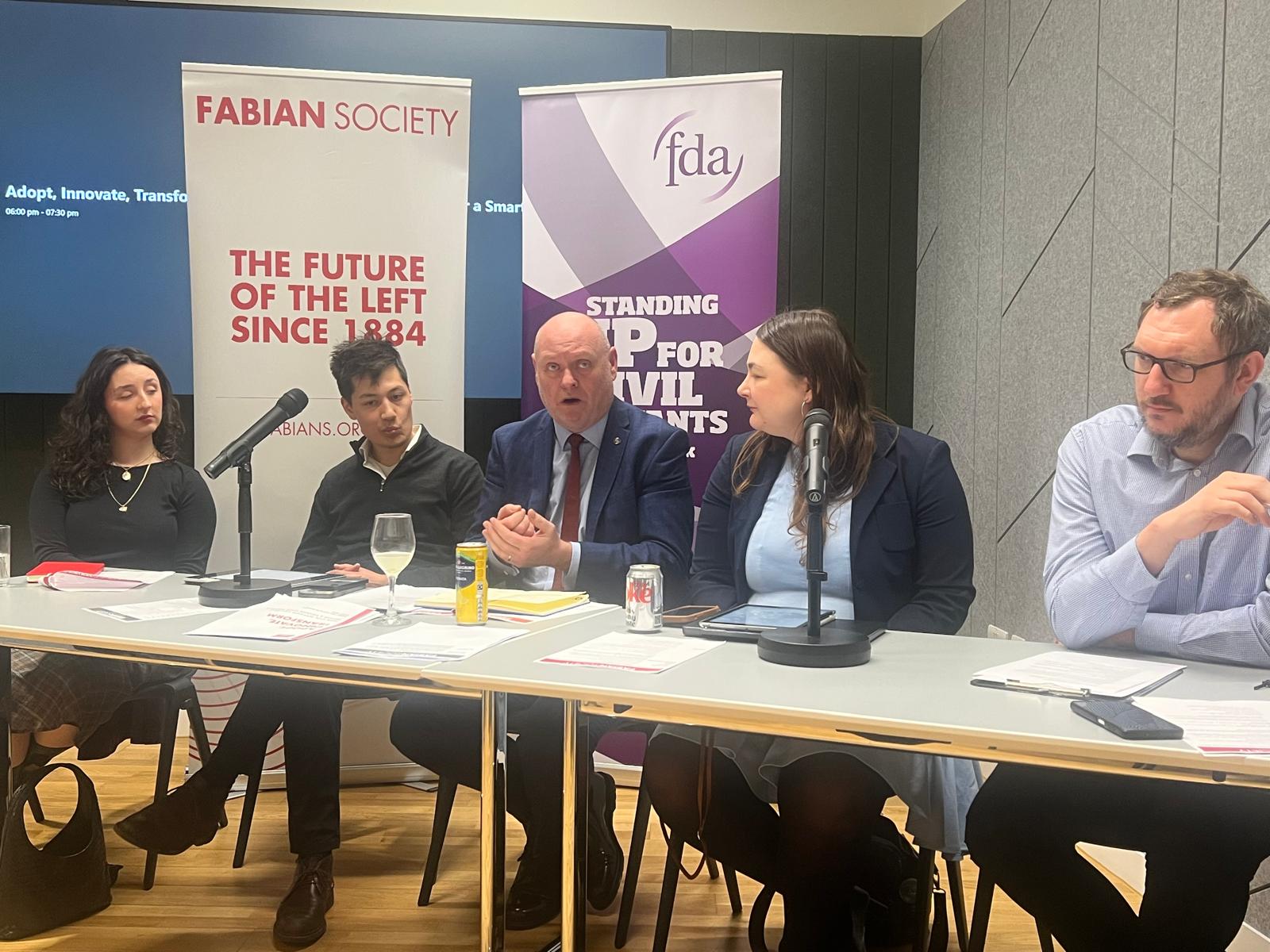
FDA and Fabian Society launch new AI report
Report co-authors Sasjkia Otto and Aoife Donaghy, alongside former No.10 Downing Street Innovation Fellow Alexander De Ville, and FDA General Secretary Dave Penman launch new joint FDA/Fabian Society report at FDA HQ in London.
-
Back civil servants to ‘rewire Whitehall’, report urges
Involve civil servants and properly invest in AI to achieve the productivity and savings the government seeks, a new report from the FDA and the Fabian Society argues.


