
Penman challenges senior political figures on civil service reform at Institute for Government conference

During the Institute for Government’s annual conference, FDA General Secretary Dave Penman questioned speakers Chief Secretary to the Prime Minister and Chancellor of the Duchy of Lancaster Darren Jones MP, Secretary for Health and Social Care Wes Streeting MP, and Shadow Chancellor Sir Mel Stride MP on key issues relating to civil service reform.
Chancellor of the Duchy of Lancaster Darren Jones appeared at the conference for an ‘In conversation’ event, during which Penman asked how he would respond to concerns over fragmentation of responsibilities, including changes to his own role, preventing civil service reform. Jones replied:
“The Chief Secretary role was created to be a full-time role. Initially with the view that I would be taking more time day-to-day on the kind of internal operations of Number 10 in terms of leadership of staffing teams…. That’s the bit that I’ve not been able to step into as much. But actually, that’s working fine, is my assessment of it after the first few months. And actually, by being in the Cabinet Office and in Number 10, my physical and political mandates in both of those places, it is delivering positive outcomes in terms of how we are bringing people together and being able to drive the system more effectively. So I think it’s ended up in a positive space.”
Following the minister’s keynote speech, Penman also questioned Health Secretary Wes Streeting on the government’s management of the abolition of NHS England, saying:
“When you made the announcement about NHS England, nine months on, we’ve got managers in both the civil service and the NHS who still don’t know if they’ve got a job or what structure they’re going to work in. So how do you support them to deliver efficiencies… deliver and improve public services and change restructure, how do you give them stability and capacity to do that at the same time?”
“What we tried to do was set out the direction of travel and why we were doing it and then go about implementation over a much longer period with staff being aware. And I have been acutely aware that causes uncertainty. And there are lots of risks that flow from that.
“We’ve tried to keep people in the loop, to be honest about where we don’t have the answers yet, to be honest about the timelines and the ducks we have to get in the row. And that’s not ideal… I’ve been very clear with their staff that the accountability for their experience of disruption is on me, not on the chief execs who are having to wrestle with that change at the same time as overseeing and trying to drive delivery in the system.”
Penman challenged Shadow Chancellor Sir Mel Stride on comments made during his keynote speech to the conference in which he outlined proposals for significant reductions to the civil service headcount if elected to government in 2029, calling for a return to 2016 levels.
Penman asked Stride how he could speculate on the size of the civil service without knowing “what the world is going to look like in 2029”, “what, if it was a Conservative government, their plan for government would be”, or “how public services will be reshaped and technology will change between now and then.” Stride responded:
“What we’d be doing is taking it back to where it was in 2016. All I would say is, look, the British state didn’t fall apart in 2016 because everybody was at the gate saying, “We need more civil servants.”… It must be perfectly reasonable to be able to get back to the kind of size which historically has worked in the past.
“Of course we can never predict the future, but that shouldn’t stop us having an aspiration and a desire to achieve a particular outcome… Otherwise, you’d end up doing absolutely nothing. You’d be constantly waiting every day for the future in order to decide what you were going to do.”
Prior to the conference Penman also challenged Stride on his pledge to increase dismissals of underperforming civil servants, which was reported in The Telegraph prior to the Shadow Chancellor’s speech, saying on X:
“Transforming public services will not happen by trotting out tired old tropes about the civil service.
“This is not the approach of a serious government, it’s an intellectually corrupt process designed to deliver a headline, not efficient or effective public services.”
Latest news
-
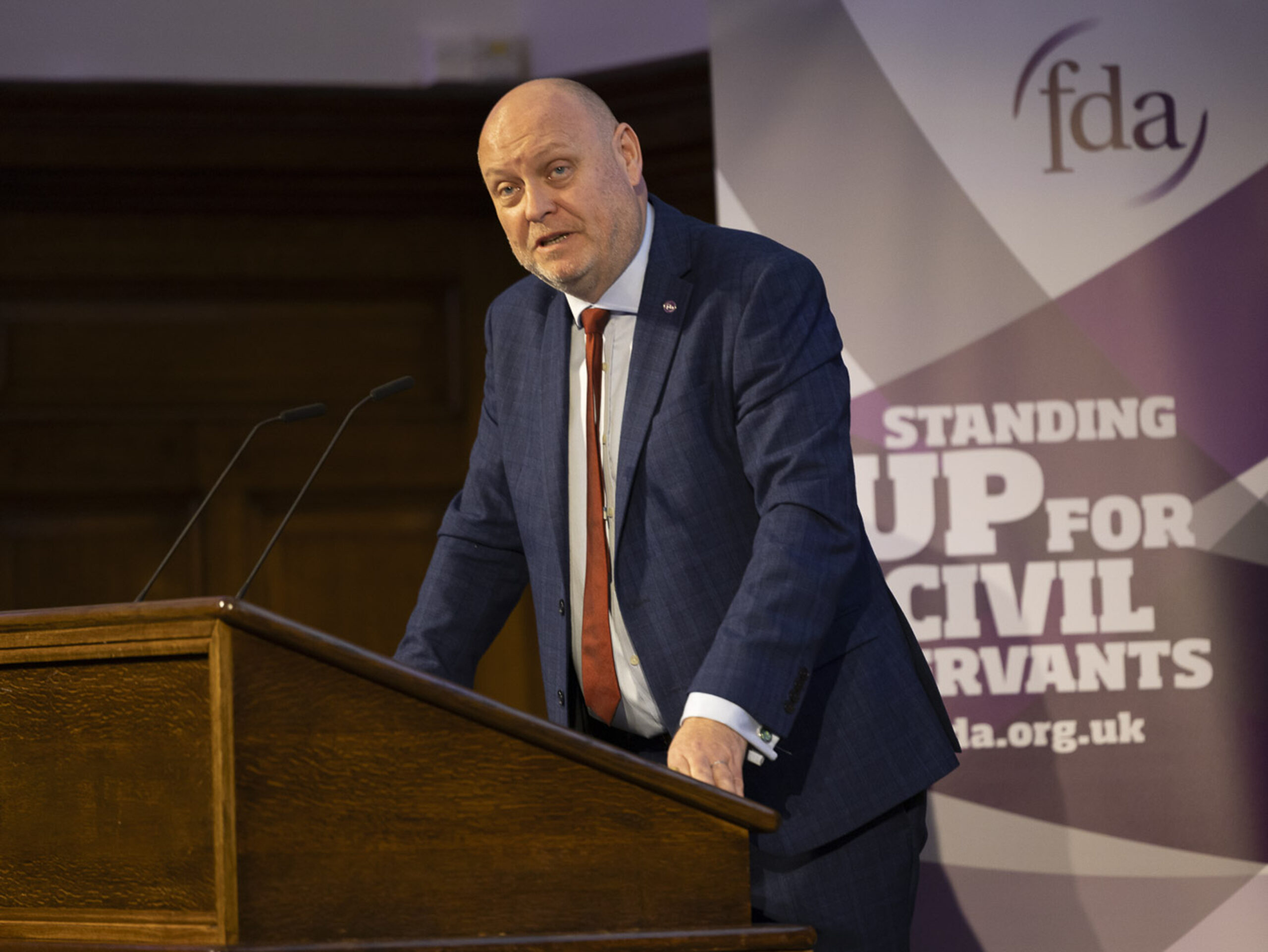
Penman re-elected
Earlier this month, it was confirmed that Dave Penman had been re-elected as General Secretary of the FDA.
-
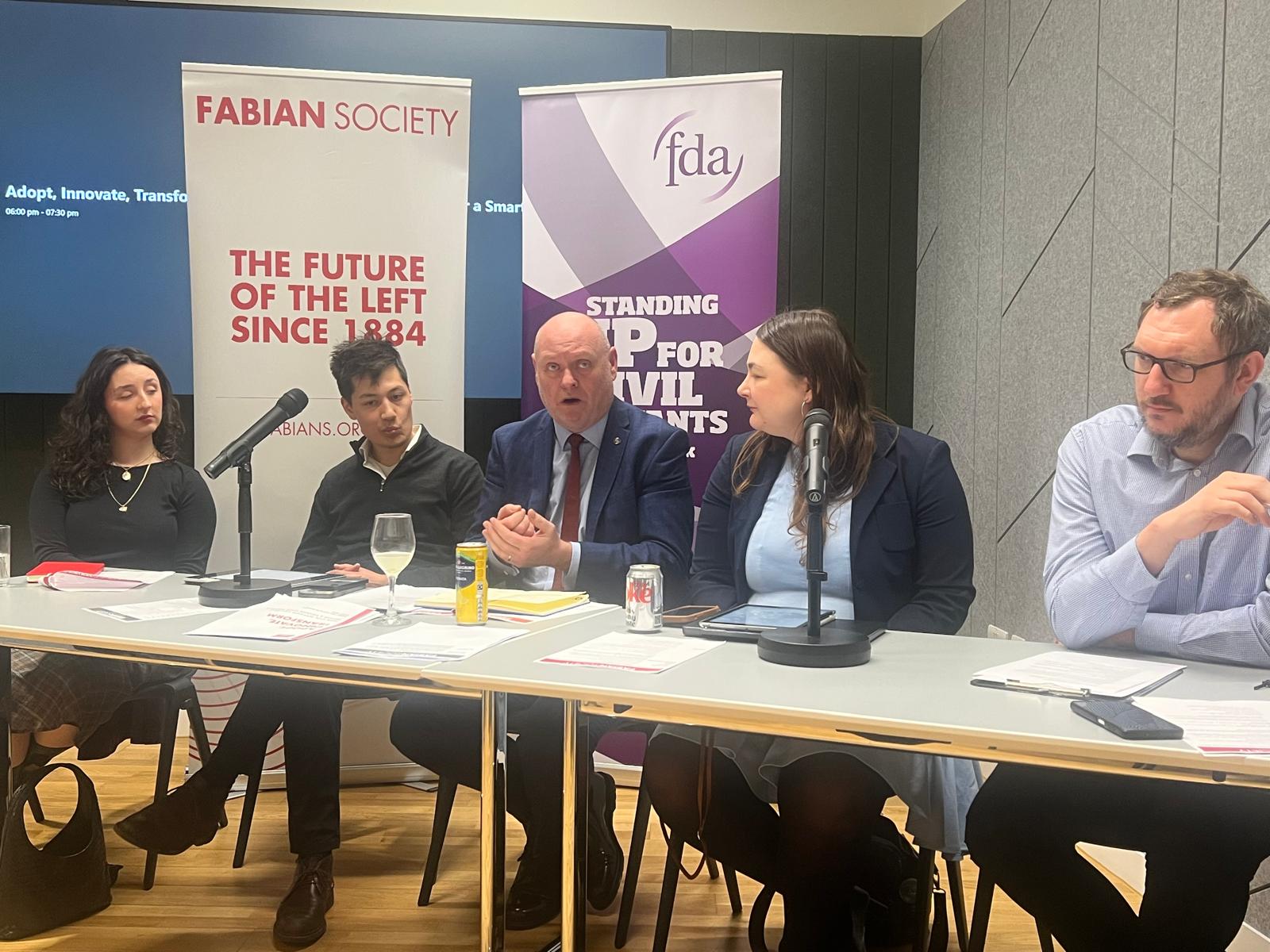
FDA and Fabian Society launch new AI report
Report co-authors Sasjkia Otto and Aoife Donaghy, alongside former No.10 Downing Street Innovation Fellow Alexander De Ville, and FDA General Secretary Dave Penman launch new joint FDA/Fabian Society report at FDA HQ in London.
-
Back civil servants to ‘rewire Whitehall’, report urges
Involve civil servants and properly invest in AI to achieve the productivity and savings the government seeks, a new report from the FDA and the Fabian Society argues.


